Pattern Probabilities in Casino Bingo: How Different Formats Influence Payout Potential
Yara Werner · Oct 4, 2026

Pattern Probabilities in Casino Bingo: How Different Formats Influence Payout Potential
Pattern probabilities play a central role in determining outcomes across casino bingo formats, where players complete designated shapes on cards through randomly drawn numbers, and different variants alter the mathematical likelihood of success along with associated payout structures. Observers note that 75-ball bingo, commonly found in North American venues, features a 5x5 grid with patterns such as single lines, diagonals, or full houses, while 90-ball bingo prevalent in European and Australian settings uses a 9x3 grid emphasizing horizontal lines and full cards. Data from industry reports indicate these structural differences shift completion rates, with researchers calculating exact probabilities based on total possible number combinations and draw sequences.
Core Mechanics Across Bingo Variants
Casino operators deploy multiple formats to accommodate varied player preferences, and each format carries distinct probability profiles tied to grid size, number range, and required patterns. In 75-ball games the total numbers span 1 through 75, which creates a larger pool compared to 90-ball versions that draw from 1 through 90 on smaller per-column ranges, and analysts have documented how these pools affect the speed at which patterns emerge during play. Studies show that full-house patterns in 90-ball bingo require covering all 15 numbers on a card, whereas 75-ball full houses cover 24 numbers excluding the free space, producing measurable differences in average draws needed for completion. Those who track gaming data observe that pattern complexity directly correlates with payout tiers, since operators adjust prize pools according to statistical rarity.
Probability Calculations for Common Patterns
Mathematical models used by gaming researchers rely on combinatorial analysis to determine the odds of completing specific patterns, and these calculations incorporate the total cards in play along with the sequence of called numbers. For instance, completing a single horizontal line in 75-ball bingo carries an approximate probability of 1 in 5 after 20 draws under standard conditions, while the same pattern in 90-ball bingo shifts due to the grid layout and number distribution. Evidence from probability studies reveals that four-corner patterns in 75-ball variants complete faster on average than blackout patterns, which require every space filled, and such distinctions allow operators to structure progressive jackpots accordingly. What's significant is how software systems in modern casinos simulate millions of draws to validate these probabilities before setting payout percentages, ensuring compliance with regulatory standards.
Maximizing Payouts Through Format Selection
Players who examine pattern probabilities often select formats that align with desired risk levels, since faster-completing patterns yield smaller but more frequent payouts while rarer patterns offer larger rewards. Data indicates that 80-ball bingo, which uses an 4x4 grid with 80 numbers, occupies a middle ground where patterns like inside squares or windmills appear at rates between those of 75-ball and 90-ball games. According to figures from the Nevada Gaming Control Board, payout percentages in regulated bingo operations range from 75 to 90 percent depending on the variant and pattern mix, with operators publishing these rates to maintain transparency. As preparations advance for the International Gaming Summit scheduled in October 2026, analysts continue reviewing how emerging digital platforms adjust these probabilities through randomized number generators certified by independent testing labs.
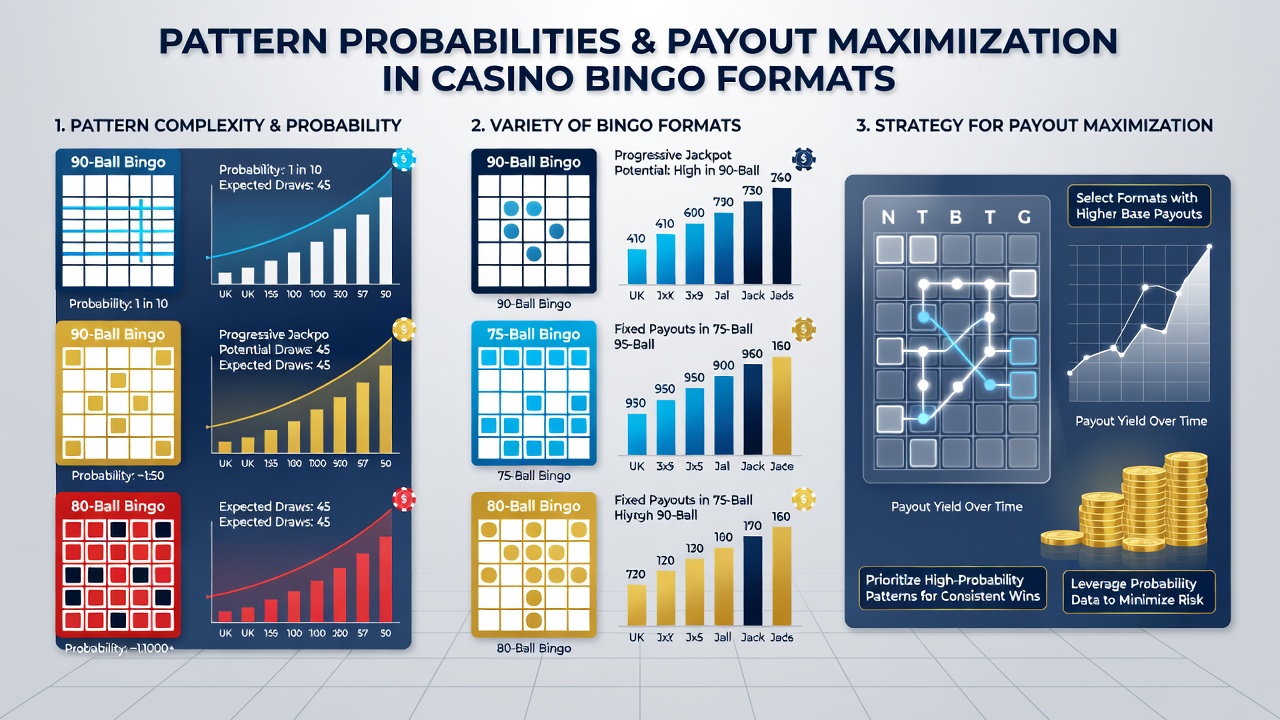
But here's the thing: multi-pattern games combine several winning shapes within a single session, which alters overall probability distributions and requires updated modeling to predict session outcomes accurately. Researchers at institutions such as the University of Nevada, Las Vegas have published papers detailing these interactions, and their work demonstrates that overlapping patterns increase the chance of multiple winners per game round. Those who study payout data find that progressive jackpots tied to blackout or coverall patterns accumulate faster in high-volume 75-ball sessions, whereas line-focused 90-ball formats distribute smaller prizes more evenly across participants.
Regional Variations and Regulatory Oversight
Geographic differences shape how casinos implement bingo patterns, with North American properties favoring 75-ball due to historical riverboat traditions while Australian and Canadian venues often emphasize 90-ball for its structured progression. Reports compiled by the Canadian Gaming Association highlight that provincial regulations require explicit disclosure of pattern odds, which helps standardize player expectations across licensed operations. Evidence suggests electronic bingo terminals further modify probabilities by enabling simultaneous play across linked machines, and this connectivity expands the number pool effectively without changing core draw mechanics. Observers note that such systems undergo rigorous audits to confirm random outcomes remain consistent with published probabilities.
Conclusion
Pattern probabilities remain a foundational element in casino bingo across all formats, where grid designs, number ranges, and required shapes determine both completion rates and payout allocations. Research continues to refine these models as new variants emerge, and regulatory bodies maintain oversight to ensure statistical integrity. Those who analyze gaming data recognize that informed format selection based on these probabilities supports structured play within established casino environments.